Back to all posts
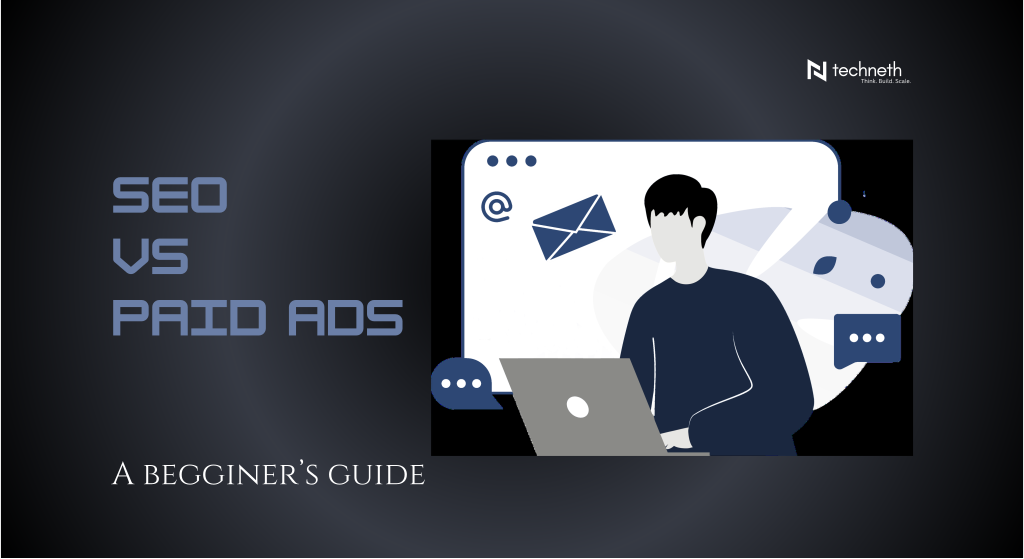
SEO vs Paid Ads: Which One Grows Your Business Faster
Thijs Smit4/24/2026• 10 min read
Do you click on the sponsored URL or the one that comes after that? Cause this is very common to avoid paid clicks. Thus, SEO is mandatory, no cap.
SEO and paid ads both drive traffic, but they work completely differently. One stops the moment you stop paying. The other compounds over time.
This is not a question with one correct answer for every business. It depends on your budget, your timeline, and how your customers search. This article breaks down the actual mechanics of each and when to use them.
The data here is drawn from published industry research and real performance benchmarks. No invented scenarios, no vague advice. Just the factors that determine which investment makes more sense for your situation.
How paid ads actually work
Paid search ads appear above organic results and are labelled as sponsored. You pay each time someone clicks your ad, regardless of whether they convert. The moment your budget runs out or you pause the campaign, the traffic stops.
Google Ads operates on an auction system where you bid on specific keywords. Higher competition keywords cost more per click, often several euros for a single visit. In saturated industries, cost per click can exceed 20 euros for one visit.
Paid ads give you control over targeting, timing, and the exact message shown. You can run a campaign today and see traffic data by tomorrow morning. That speed and control is the primary reason businesses use paid advertising at all.
The trade-off is dependency. Your traffic is rented, not owned. Paid ads are a tap. Traffic flows only while the tap stays open.
How SEO actually works
SEO is the process of making your site earn rankings through relevance and authority. Google evaluates hundreds of signals: content quality, site speed, backlinks, and structure. The goal is to be the most useful result for a given search query.
Rankings take time to build. Most competitive keywords require three to six months minimum. That upfront cost deters many businesses. That is exactly why earned rankings have real value.
Once your pages rank, traffic arrives without ongoing cost per click. A ranking article can bring consistent traffic for years after publication. The cost of that content stays fixed while the return compounds over time.
SEO also captures demand at the moment of intent. Someone searching for a specific solution is already looking for what you offer. That intent-matching is why organic traffic converts at a different quality than most paid sources.
The cost comparison over time
In the short term, paid ads almost always deliver faster results than SEO. If you need leads this week, SEO will not help you get them. Paid campaigns can be live and driving traffic within hours of setup.
Over twelve months, the calculation shifts significantly. SEO traffic grows as rankings build, while the cost of producing content remains fixed. Paid traffic costs the same per click in month twelve as month one.
A study by BrightEdge found that organic search drives 53% of all website traffic. Paid search accounts for around 15% across most industries on average. The organic share is larger because most users click past sponsored results to organic ones.
WordStream data shows average Google Ads conversion rates sit around 3.75% for search. SEO-driven traffic typically converts between 2.5% and 5% depending on intent and page quality. The gap closes when paid traffic is sent to purpose-built landing pages rather than homepages.
For businesses that cannot afford to wait, paid ads bridge the gap while SEO builds. Running both simultaneously is the most defensible long-term position. You capture immediate demand with ads while building the asset that reduces cost over time.
How your technical foundation affects both channels
A slow website hurts both paid and organic performance at the same time. Google Ads uses Quality Score to set your ad position and your cost per click. A slow page raises your ad costs. Page experience is part of that score.
For SEO, performance optimization is a direct ranking factor. Google measures Core Web Vitals and uses them as part of the page experience signal. A site failing those metrics ranks below an equivalent site that passes them.
UI/UX design affects conversion rate regardless of how the traffic arrived. Paid traffic sent to a poorly designed page wastes the ad spend completely. Organic traffic landing on a confusing page converts at the same low rate.
The technical foundation of your site is the multiplier for both channels. Fix the foundation first and every euro spent on traffic works harder. A technical architecture review surfaces the specific issues holding your site back.
When paid ads are the right primary channel
Paid ads are the right primary channel when you need results on a fixed timeline. A product launch, a seasonal campaign, or a new market entry all suit paid well. You control the exact message, the exact audience, and the exact timing.
For high-margin products and services, the cost per click is easier to absorb. If a single converted customer is worth 2,000 euros, a 20-euro click cost is manageable. The unit economics have to be calculated before dismissing paid ads as too expensive.
Landing page development matters enormously for paid campaigns. A dedicated landing page built for one specific offer converts better than a homepage. The combination of targeted ad and matched landing page is where paid performs best.
Retargeting campaigns perform better than cold prospecting for most service businesses. A prior site visitor converts at a higher rate on second contact. Paid retargeting extends the value of SEO traffic by recapturing visitors who did not convert.
Paid ads also let you test messaging and audience before committing to SEO content. A headline that gets clicks in ads is worth building SEO content around. The data from paid campaigns informs smarter SEO strategy rather than replacing it.
When SEO is the right primary investment
SEO is the right primary channel when your customers search before they buy. When purchase decisions start with a Google search, organic visibility is the asset. Missing from page one means missing from that decision entirely.
For SaaS platforms, SEO builds the trust layer that paid ads cannot replicate. Technical buyers research extensively before committing to a software product. Case studies, documentation, and educational content rank organically and build authority over time.
MVP development teams benefit from SEO content that validates demand before full product build. Blog traffic around a problem confirms whether the market is searching for a solution. That data reduces investment risk before a single line of product code is written.
Digital transformation consulting often surfaces SEO as the highest-ROI channel for established businesses. The channel is underinvested relative to paid because its returns are slower and less visible. That underinvestment is exactly why there is competitive opportunity for businesses willing to commit.
AI search and what it changes for both channels
AI-powered search is changing how results are presented to users significantly. Google now generates direct answers at the top of results, reducing clicks to some pages. This makes content quality and structured data more important than keyword density alone.
Pages that answer questions clearly and specifically perform better in AI-generated summaries. Vague, keyword-stuffed content loses visibility while genuinely useful content gains it. The direction of search rewards the same investment that good SEO has always required.
AI-powered search and recommendations on your own site also drive internal discovery. Users finding content via on-site search convert at higher rates than browsers. Building that capability into your site extends the SEO investment further down the funnel.
Paid ads are less affected by AI search changes in the short term. Sponsored placements exist separately from AI-generated answers in most current implementations. But as AI summaries become more prominent, ad click-through rates on informational queries may drop.
Running both channels in practice
Most businesses at growth stage benefit from running both channels in parallel. Paid ads capture demand now while SEO builds the infrastructure for lower acquisition costs later. The two channels inform each other when you track data from both properly.
Business process automation connects your ad platform data to your CRM and analytics stack. Seeing which keywords produce customers rather than just clicks changes how you spend. That visibility is the difference between a marketing budget and a marketing investment.
Allocating budget between SEO and paid is a decision based on your stage and margin. Early-stage businesses with no existing rankings and tight timelines lean toward paid first. Established businesses with healthy margins should be shifting spend toward organic over time.
A tech partnership helps you model the right allocation based on your actual numbers. The decision should be based on your unit economics, not industry opinion. Both are tools. The question is which one fits the job right now.
Why this matters to us
At Techneth we build the technical foundation that makes both channels perform better. A fast, well-structured site improves Quality Score for paid and rankings for SEO simultaneously. The investment in the right technical base pays dividends across every traffic source you use.
We see businesses spend heavily on ads while their site converts at under two percent. The problem is rarely the targeting. It is almost always the landing page. Fixing that page is cheaper than increasing ad spend to compensate for poor conversion.
The choice between SEO and paid is rarely either-or in practice. It is a sequencing question: what to build first and what to run meanwhile. We help businesses answer that question based on data, not instinct.
Ready to build a strategy based on your actual numbers?
Talk to Techneth about a tech partnership that maps the right channel mix for your stage and goals.
Also relevant: Technical Architecture Review | Performance Optimization | Landing Page Development
FAQ
Is SEO or paid ads better for business growth?
SEO delivers sustainable, compounding traffic but takes three to six months to produce results. Paid ads deliver immediate traffic that stops when budget does. The right choice depends on your timeline, margin, and how your customers search.
Which industries benefit most from paid advertising?
Industry competition and keyword cost per click determine paid ad profitability most directly. High-margin services and products with strong search intent suit paid well. Low-margin or high-competition markets often make SEO the more cost-effective long-term channel.
How does site speed affect SEO and paid ad performance?
Google's Core Web Vitals measure load speed, visual stability, and interactivity directly. Sites failing those thresholds rank below equivalent sites that pass them. Speed and structure are not optional for any business serious about organic rankings.
How much should a business spend on paid ads?
Most small businesses start paid budgets between 500 and 2,000 euros monthly. Below that threshold, campaigns often lack enough data to optimise effectively over time. SEO investment is typically in content and technical work rather than ongoing media spend.
Can SEO and paid ads work together?
Both channels can run simultaneously and they inform each other when tracked properly. Ad data reveals which messages and keywords resonate before you commit to SEO content. SEO rankings reduce dependency on paid over time and lower overall acquisition cost.
How does AI search change SEO strategy?
AI search rewards clear, well-structured content that directly answers specific questions. Keyword-stuffed or thin content loses visibility as AI-generated summaries take prominence. Structured data, fast load times, and genuine content quality matter more than before.
Resources
Latest from the blog
The latest industry news, technologies, and resources.
Ready to start your next project?
Join over 4,000+ startups already growing with our engineering and design expertise.
Trusted by innovative teams everywhere