Online Stores Designed to Sell
Online stores built to load fast, guide people through checkout, and bring them back for the second order. Shopify, WooCommerce, or a custom platform, chosen for how you actually sell.
Overview
What is E-commerce Development?
E-commerce development is the process of building an online store that can present products, take payment, and connect to the systems behind the sale. It covers platform choice, storefront design, product and checkout pages, payment and shipping integration, and the performance work that keeps pages fast.
Platform first, because that choice shapes everything after it. Shopify when you want to launch quickly on a managed platform, WooCommerce when content and commerce sit together on WordPress, and a custom or headless build when your pricing, catalogue, or B2B rules do not fit either. From there the work is the storefront, the product pages, the checkout, and the connections to payments, shipping, inventory, and your CRM or ERP. Everything is tested on real devices and real network conditions before launch.
Capabilities and features
The Right Platform for How You Actually Sell
Platform choice is the most consequential decision in an e-commerce project, and it should follow your catalogue, your margins, and your operations rather than a preference. The trade offs are laid out in plain terms before anything is committed, including what each option costs to run in year two.
- Shopify for a fast launch on a managed platform with less to maintain
- WooCommerce when content and commerce need to live in the same place
- Custom or headless when pricing, catalogue, or B2B rules need real logic
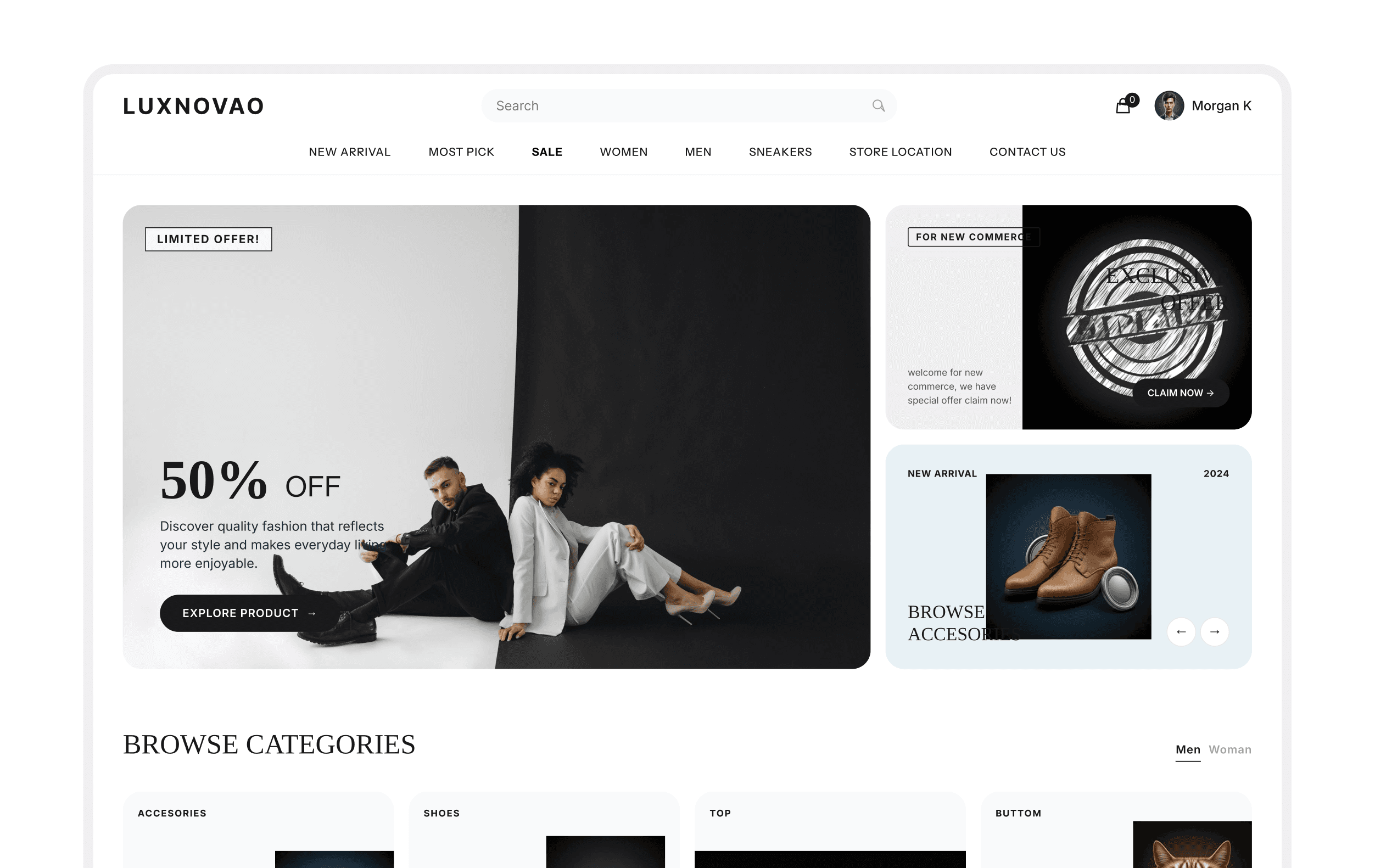
Product Pages and a Checkout That Get Out of the Way
The product page is where the decision happens and the checkout is where it gets lost. Both are built around the things that measurably help: honest imagery, clear delivery and returns information, visible trust signals, and the shortest path from add to cart to confirmed order.
- Guest checkout, minimal fields, and address autocomplete as standard
- Stripe, PayPal, Apple Pay, Google Pay, and local methods for your market
- Baymard Institute puts cart abandonment near 70 percent, so the flow gets tested end to end

Built Mobile First, Not Mobile Adapted
Most storefront traffic arrives on a phone, so layouts, images, and interactions are designed for a small screen before they are scaled up. In practice that means thumb reachable controls, images that do not blow the data budget, and a checkout that works one handed.
- Layouts drawn for phones first, then scaled up to desktop
- Core Web Vitals work built in: image compression, lazy loading, clean URLs
- Tested on real devices and throttled connections, not just a desktop browser
The real impact
Why it matters
In a store, friction is measurable. A slow product page, a checkout with too many fields, or a mobile layout that fights the thumb all show up directly in the conversion rate. Fixing those is usually cheaper than buying more traffic, and the gain compounds on every visit after it.
The market is still growing rapidly. Online retail will account for 21.1% of all retail sales globally.
Source: Shopify Global Ecommerce Sales Report, 2026
Three out of four shoppers add items to their cart and leave without buying. Checkout optimisation is the highest-leverage improvement most stores can make.
Source: ConvertCart / Speed Commerce, 2025
Page speed is directly tied to revenue. A one-second delay costs you measurably. Fast stores sell more.
Source: Multiple Sources / Industry Benchmark
Technologies we build with
 Python
 TypeScript
 Node.js
 Laravel
 Django
 Next.js
 React
React TailwindPythonTypeScriptNode.jsLaravelDjangoNext.jsReactTailwind
 Docker
 MySQL
MySQL PostgreSQL
 MongoDB
 Supabase
 Redis
Redis AWSDockerMySQLPostgreSQLMongoDBSupabaseRedisAWS
Explore more
Related services
More ways we help teams with web development.
FAQ
Frequently asked questions
Everything you need to know about this service.
A Shopify store with a customised theme and standard integrations usually takes four to eight weeks. WooCommerce with custom functionality runs six to twelve weeks. A fully custom or headless build takes four to eight months. Product count, checkout complexity, and how fast content arrives move the date more than anything else.
Ready to start your next project?
Let us turn your idea into software that scales. Book a free consultation and we will map out the build with you.
Trusted by the teams we build with