Why legacy modernization moved to the top of the IT agenda
What does this guide cover?
- Why legacy modernization moved to the top of the IT agenda
- What is legacy system modernization?
- Why businesses modernize legacy systems
- The main legacy modernization approaches
- How a modernization project actually runs
- What drives the cost of legacy modernization
- Questions people ask before they modernize
- Where modernization fits your wider roadmap
- Why getting modernization right matters now
- Legacy modernization by the numbers
- What clients ask us about legacy modernization
- Frequently asked questions about legacy system modernization
- Planning your legacy modernization project
Most companies do not wake up one day and decide to modernize. It creeps up on you. A vendor drops support for a database, a key developer who understood the old code retires, an integration you needed last week turns out to be impossible on the platform you have. By the time legacy system modernization lands on the roadmap, the system is usually already holding the business back. This guide walks through what modernizing a legacy system means, the real approaches you can take, what shapes the cost, and how a project runs from first discovery call to a system your team can build on again. No jargon, no scare tactics, just the way we at Techneth think about legacy application modernization when a client asks us where to start.
What is legacy system modernization?
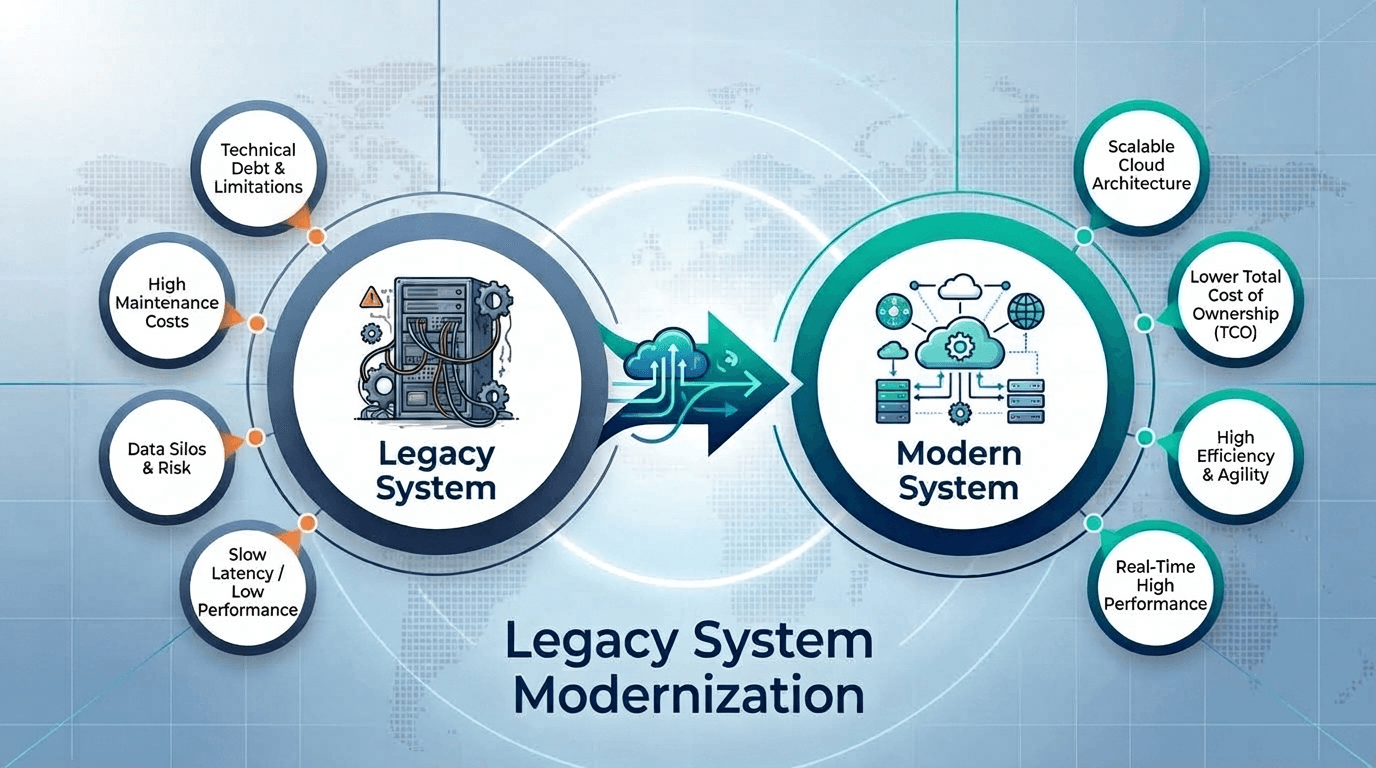
Legacy system modernization is the process of updating outdated software, applications, or infrastructure so they meet current business and technical needs. It can mean moving a system to the cloud, restructuring its code, rebuilding it, or replacing it entirely, without throwing away the value the old system still delivers every day.
Worth clearing up one myth early. A legacy system is not defined by age. Plenty of ten year old software runs beautifully. A system becomes legacy when its technology, architecture, or the skills needed to maintain it start to limit what the business can do. That old inventory tool might still work fine on a Tuesday. The problem is the Wednesday when you need it to talk to a new sales platform and it simply cannot.
Why businesses modernize legacy systems
The cost of standing still
The strongest case for modernizing rarely shows up as a single line in a budget, which is exactly why it gets ignored. Keeping an aging system alive is expensive in ways finance does not always see. Gartner has estimated that around 40 percent of IT budgets get consumed by technical debt, and much of that debt lives inside legacy applications. Developers feel it directly. Research puts the share of engineering time spent wrestling with old code and maintenance at roughly a third, time that is not going into anything new.
Then there is risk. Older systems miss security patches, rely on components no longer supported, and store data in ways that make compliance harder. With the global average cost of a data breach sitting near 4.4 million dollars, an unpatched legacy platform is not a small liability. Add the talent problem, specialist contractors for languages like COBOL now command 180 to 250 dollars an hour because so few people still know them, and the maintenance bill only climbs. Doing nothing has a price. It just arrives quietly.
What you gain by modernizing
On the other side of the ledger, a modernized system gives you room to move. You can integrate with new tools instead of building fragile workarounds. You can scale when demand spikes rather than praying the server holds. Security improves because you are back on supported, patchable technology. And your engineers spend their weeks shipping features customers notice, not nursing code nobody wants to touch. Many teams also modernize as the first step toward cloud migration, since a cloud-native foundation is what makes everything after it easier.
The main legacy modernization approaches
There is no single way to modernize, and anyone who tells you otherwise is selling something. The right move depends on how healthy the existing code is, how critical the system is, and how much change the business can absorb at once. Practitioners often frame the options as the seven Rs. Frameworks vary a little, some list six, some add retire, but the practical set looks like this.
The seven modernization paths at a glance
| Approach | What it means | Effort and cost | Best when |
|---|---|---|---|
| Retain | Leave the system as is, for now | Lowest | It still works and is not blocking anything |
| Rehost | Move it unchanged to modern infrastructure, often called lift-and-shift | Low | You need quick infrastructure wins without touching code |
| Replatform | Move it with light changes to gain cloud benefits | Low to medium | You want cloud gains but not a full rewrite |
| Refactor | Restructure the code without changing what it does | Medium | The logic is sound but the code is hard to maintain |
| Rearchitect | Reshape it into a modern architecture such as microservices | High | Scaling and speed of change are the real problem |
| Rebuild | Rewrite from scratch, keeping the same scope | High | The codebase is beyond saving but the need remains |
| Replace | Swap it for a commercial or SaaS product | Medium | An off-the-shelf tool now covers the job well enough |
The pattern to notice is that effort rises as you move down the list, but so does the upside. Rehosting buys you time. Rearchitecting into a microservices architecture buys you a system that can keep changing for years. Most real projects mix a few of these rather than picking one.
How to choose the right approach
Ask three questions. How much business value does this system still deliver? How much pain is the current technology causing? And how much disruption can the team tolerate right now? A system with high value and high pain justifies rearchitecting or rebuilding. Low value and low pain usually means retain, or replace with something you buy. The honest answer is often a phased plan, rehost first to stop the bleeding, then refactor the parts that matter most. Beware the instinct to rebuild everything from scratch because the old code is ugly. Ugly and working still beats beautiful and late.
How a modernization project actually runs
Discovery before code
Good modernization starts with understanding, not coding. Before we at Techneth propose anything, we study how the system is actually used, where the data lives, which integrations it feeds, and which parts of it the business genuinely depends on. That discovery step is where most surprises hide, the undocumented workaround someone built in 2016 that three departments now rely on. Skipping it is how modernization projects quietly go over budget. If you take one thing from this section, make it that. Map the system before you touch it.
Modernizing in increments, not big bangs
Legacy systems are usually critical, which makes the big-bang switchover, shut it all down, turn the new one on, a genuinely risky move. The safer path is incremental. You modernize one slice at a time while the old system keeps running, so the business never goes dark. We work in two-week sprints with a working demo at the end of each, so you see progress every week rather than waiting months for a reveal. It is slower to describe and far less scary to live through. This is the heart of how we handle legacy modernization, steady, visible, and safe for a live business.
What drives the cost of legacy modernization
The factors that move the price
Nobody can quote a legacy modernization project off a single sentence, and you should be wary of anyone who tries. The cost swings on a handful of factors. The approach comes first, a rehost is a fraction of the price of a rebuild. Then the size and messiness of the codebase, how well it is documented, how many integrations depend on it, and how strict the compliance requirements are. Data migration is its own line item and often underestimated. The last factor is timeline, because a rushed schedule usually costs more, not less. What we can promise is honesty about the number, including pushing back when a cheaper approach would serve you better than the expensive one you asked for.
Questions people ask before they modernize
A few questions come up in almost every first conversation. How is this different from digital transformation? Modernization is the technical work of updating systems. Digital transformation is the broader business change that modernization often makes possible. One is a building block, the other is the building. Can we modernize without downtime? Usually yes, through the incremental approach above, running old and new side by side until the switch is safe. Should we modernize or just replace? If an off-the-shelf product genuinely covers your needs, replacing can be the smart, cheaper call. If your system encodes something specific to how you operate, that specificity is worth keeping, and modernizing protects it.
Where modernization fits your wider roadmap
Legacy modernization rarely stands alone. It tends to sit at the front of a longer plan that touches infrastructure, data, and the business systems your team uses daily. If your legacy pain centers on business software rather than custom applications, the trade-offs shift, and our breakdown of custom ERP versus off-the-shelf software is a useful companion read. For anything platform level, the same principles carry straight into backend and API development, which is often where a modernized system finally gets the connections it always needed.
Why getting modernization right matters now
There is a timing angle that was not true a few years ago. The tools everyone wants to adopt next, AI features, real-time analytics, automation, all assume a clean, connected, modern foundation. A legacy system does not just cost you today. It quietly blocks the things you will want to do in two years. That is why modernization has shifted from an IT housekeeping task into a board-level decision. The organizations that treat it as strategic get to build on top. The ones that keep deferring find the gap harder and more expensive to close each year. If that is where you are, a good first move is a clear-eyed look at your current stack, and you can see the full range of what we build across our software development services.
Legacy modernization by the numbers
The scale of this is easy to underestimate. The application modernization market is worth roughly 27.5 billion dollars in 2026 and is on track for about 68 billion by 2031, growing near 20 percent a year, with North America holding close to 39 percent of it. Demand explains the growth. In one industry survey, 73 percent of organizations called legacy modernization significant or central to their software strategy. The cost of ignoring it is just as large, poor software quality and accumulated technical debt were estimated to cost the US economy around 2.4 trillion dollars in a single recent year.
© techneth.com
We have never regretted spending an extra week in discovery, and we have never met a client who regretted it either. The failed modernizations we get called in to rescue almost always skipped that step. Read how that principle shapes the way we work on our about Techneth page.
What clients ask us about legacy modernization
How long does a legacy modernization project take?
It depends on the approach. A rehost can take a few weeks, a full rebuild several months. We work in two-week sprints with a demo at the end of each, so you see working results every week and can adjust scope as we go rather than waiting for a single reveal at the end.
How do you price a modernization project?
After discovery, once we understand the codebase, integrations, and data. We give you an honest number tied to a defined scope, and we will tell you when a cheaper approach would serve you better. No vague estimates that balloon later. Pricing follows the plan, not the other way around.
Will we own the code and IP afterward?
Yes. You own the code and the intellectual property outright. There is no lock-in to us as a vendor. A modernized system that only we can maintain would defeat the point, so we build it to be handed over and kept running by your team if you choose.
How do you avoid disrupting our live system?
We modernize incrementally, running the old and new systems side by side and switching over one slice at a time. The business keeps operating throughout. We also handle data migration carefully, since that is where most disruption hides, and test each stage before it goes live.
Do you support the system after launch?
We stay through launch and beyond, including App Store submission where relevant and ongoing post-launch support. Modernization is not a hand-off at go-live. We work as part of your team, so you are not left alone with a new system the moment it ships.
Do you work with startups as well as established companies?
Both. We have delivered 50 plus projects across startups and small to mid-size businesses, backed by a team of 20 plus engineers and a 99.9 percent uptime standard. Whether you are modernizing one aging tool or planning a larger transformation, the discovery-first approach is the same.
Frequently asked questions about legacy system modernization
What is legacy system modernization?
It is the process of updating outdated software, applications, or infrastructure so they meet current business and technical needs. Depending on the situation it can mean moving a system to the cloud, restructuring its code, rebuilding it, or replacing it, while keeping the value the old system still provides.
What are the 7 Rs of application modernization?
Retain, rehost, replatform, refactor, rearchitect, rebuild, and replace. They describe the range of options from leaving a system alone, through lifting it to new infrastructure, all the way to a full rewrite or swapping in a commercial product. Most real projects combine two or three of them.
Why is legacy system modernization important?
Aging systems drain budgets, create security risk, and block integration with newer tools. Around 40 percent of IT budgets go to technical debt, much of it in legacy code. Modernizing frees that spend, reduces risk, and lays the foundation for things like AI and automation that legacy platforms cannot support.
How much does legacy system modernization cost?
There is no fixed figure. Cost depends on the approach, the size and condition of the codebase, the number of integrations, data migration, and compliance needs. A simple rehost is a fraction of a full rebuild. The reliable way to get a number is a discovery phase that scopes the actual work.
What are the risks of not modernizing legacy systems?
Rising maintenance costs, growing security exposure as support ends, difficulty hiring people who know the old technology, and an inability to adopt newer tools. The risk compounds. Each year of delay makes the eventual project larger, and it quietly limits what the business can do next.
What is the difference between legacy modernization and digital transformation?
Modernization is the technical work of updating systems. Digital transformation is the broader change to how the business operates that modernization enables. Modernization is often a first step inside a larger transformation, but the two are not the same thing and should not be confused in planning.
How long does legacy modernization take?
Anywhere from a few weeks for a straightforward rehost to several months for a rearchitecture or rebuild. Working incrementally in short sprints lets you see progress continuously and put improvements into use before the whole project is finished, rather than waiting for a single large delivery.
What is an example of a legacy system?
A common one is an old on-premise application built in an outdated language such as COBOL or legacy .NET that still runs core operations but cannot integrate with modern tools. It is not the age that makes it legacy, it is that its technology now limits what the business can do.
Should you modernize or replace a legacy system?
Replace when an off-the-shelf product genuinely covers your needs and the system holds nothing unique. Modernize when the system encodes something specific to how you operate, because that specificity is worth protecting. The choice is a business decision as much as a technical one.
How do you modernize a legacy system without downtime?
By modernizing in increments and running the old and new systems in parallel, switching one piece at a time once each is tested and safe. The business keeps operating throughout. Careful data migration and staged rollout are what keep a live system available while it is being rebuilt underneath.
Planning your legacy modernization project
If you have read this far, you probably have a system in mind already. The next step is not a big commitment, it is a conversation about where your current stack helps you and where it holds you back. The best way to start is to book a free consultation, and we will map out a realistic starting point together.
You can learn more about Techneth and how we work, browse our full range of services including cloud migration and microservices architecture, see real results in our portfolio, or reach the team directly through our contact page.
A good next step, before any code, is a clear view of what you already have. Take a look at the kind of systems we have built and decide where your own should go next.