When your systems refuse to talk to each other
Do you need custom middleware development?
- When your systems refuse to talk to each other
- What is custom middleware development?
- When your business needs custom middleware
- Custom middleware or off-the-shelf connectors
- What we build, and how we build it
- What custom middleware development costs
- Why reliable middleware is worth getting right
- Middleware and integration by the numbers
- What clients ask us about middleware development
- Frequently asked questions about custom middleware development
- Get a custom middleware quote
Your ERP does not talk to your CRM. Your new cloud tool cannot read the data trapped in a system from 2011. Every workaround your team built is one update away from breaking. That is the daily reality custom middleware development is built to end. We at Techneth build tailored integration layers that connect your applications, databases, and third-party platforms into one reliable system, so data flows where it needs to and stops falling through the gaps. Whether you need a single connector or a full messaging layer across cloud and on-premise environments, this page covers when custom middleware makes sense, what it costs, and how we deliver it. If you already know what needs connecting, book a free consultation and we will scope it with you.
What is custom middleware development?
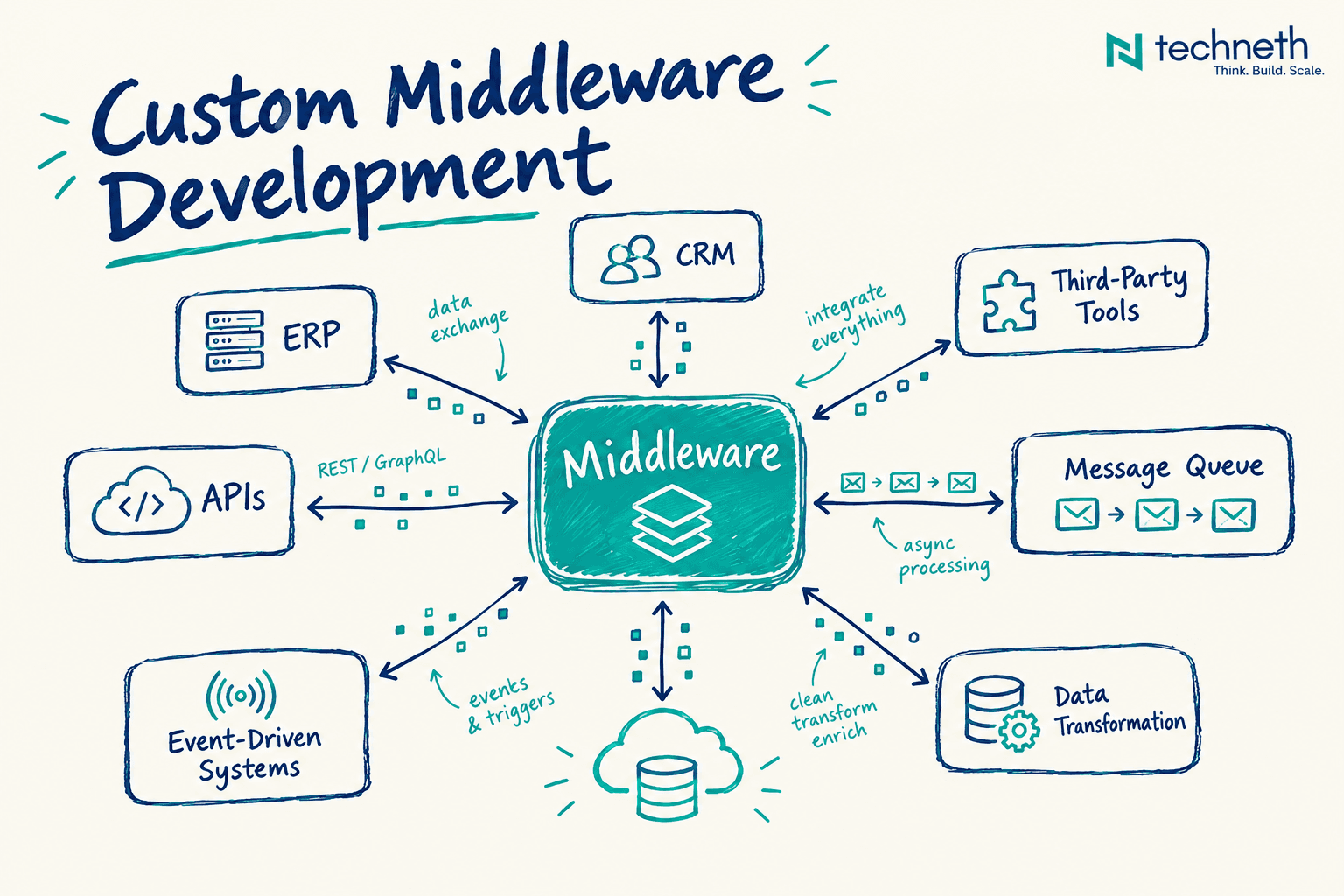
Custom middleware development is building a tailored software layer that connects your applications, databases, and APIs so they exchange data reliably. Unlike off-the-shelf connectors, it fits your exact systems and workflows, which matters when generic tools cannot handle your legacy, proprietary, or high-volume systems.
Need this built for your stack? Book a free consultation with Techneth and tell us what needs connecting.
When your business needs custom middleware
The signs off-the-shelf connectors have run out
Ready-made connectors are fine for connecting two popular apps in a standard way. You need custom middleware development when you outgrow them, and the signs are usually clear. You are integrating a legacy or proprietary system that no vendor makes a connector for. Your workflows are specific enough that a generic tool forces you to change how you work rather than the other way around. You are moving real-time data at a volume that off-the-shelf tools choke on. Or you are stitching together cloud and on-premise systems that were never meant to meet. When the cost of subscriptions, manual work, and brittle patches starts to rival the cost of building it right, custom is the cheaper answer over time. Middleware is also often the quiet engine behind legacy system modernization, letting old systems work with new tools without a full rebuild.
Custom middleware or off-the-shelf connectors
Both have a place, and we will tell you honestly when a ready-made connector is all you need. Here is how the two compare on the factors that decide it.
The rule of thumb, use ready connectors for simple, standard links and custom middleware for the mission-critical or complex ones. Many businesses run both.
What we build, and how we build it
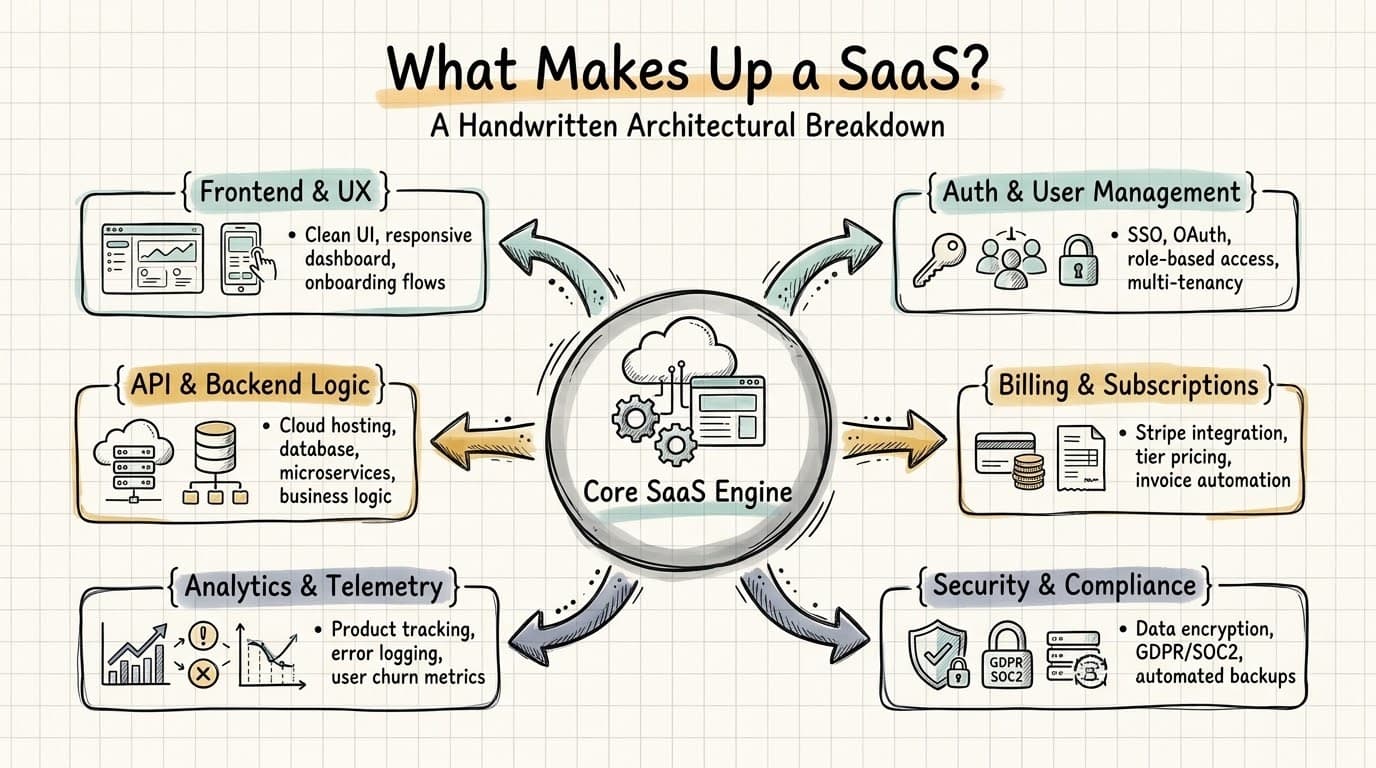
We build the full range of middleware, custom integration layers between your ERP, CRM, and third-party tools, message queuing and event-driven architectures, API orchestration, and data transformation pipelines that keep records consistent across systems. It runs across cloud, on-premise, and hybrid environments, and it is built for the reliability and performance that enterprise operations demand. The middleware itself usually sits on solid backend and API development, and for systems built on independent services, it connects cleanly into a microservices architecture.
How a middleware project runs with us
We start with discovery, mapping exactly what needs connecting and how data should move, before we write any code. Then we build in two-week sprints with a working demo at the end of each, so you see the integration come together rather than waiting months for a reveal. You own the code and the intellectual property outright, with no lock-in to us, and we build to enterprise-grade security standards including SOC2, GDPR, and HIPAA where they apply. We stay on after launch too, because middleware sits at the center of your operations and needs to keep working as your systems change. Backed by 50 plus projects and a 99.9 percent uptime standard, we build integrations meant to last.
Ready for a middleware development quote? Book a free consultation and we will scope it with you.
What custom middleware development costs
There is no flat price, and you should be wary of anyone who quotes one without seeing your systems. Cost is driven by how many systems you are connecting, how standard or proprietary they are, the volume and complexity of the data moving between them, and the security and compliance requirements involved. A single connector between two systems is a modest project. A real-time integration layer across a dozen legacy and cloud applications is a larger one. What we commit to is an honest number tied to a defined scope after discovery, and pushing back when a simpler, cheaper approach would serve you just as well. You will know what you are paying for before we start.
Why reliable middleware is worth getting right
Middleware is invisible when it works and catastrophic when it does not. It sits between the systems that run your business, so a fragile integration means orders that do not sync, data that goes stale, and teams patching by hand. Getting it right buys you clean data, automated workflows, and systems that can change without everything else breaking. As more of your stack moves to the cloud and AI tools start demanding connected, real-time data, that reliable integration layer stops being a backend detail and becomes the thing that lets you adopt anything new at all. If your systems need to work together properly, our backend and API development team is where that starts.
Middleware and integration by the numbers
The demand for connected systems is enormous and still climbing. The global middleware software market is worth roughly 94.7 billion dollars in 2026, up from 88.9 billion in 2025, and is heading toward about 122.6 billion by 2030. The enterprise application integration market is growing faster still, around 14 percent a year toward 45 billion dollars by 2030, and cloud-based integration platforms are among the fastest-growing software segments of all. North America holds the largest share of the middleware market, at roughly 36 percent.
© techneth.com
Middleware is the plumbing of a business. Nobody notices it until it leaks, and by then the whole system is flooded. We build it so it never leaks. That reliability-first approach runs through everything on our services.
What clients ask us about middleware development
How much does custom middleware development cost?
It depends on how many systems you connect, how proprietary they are, the data volume, and compliance needs. A single connector is a modest project, a real-time layer across many systems is larger. After discovery we give you an honest number tied to a defined scope, with no surprises later.
How long does a middleware project take?
A straightforward connector can take a few weeks, a complex integration layer several months. We work in two-week sprints with a demo at the end of each, so you see progress continuously and can adjust scope as we go rather than waiting for a single delivery at the end.
Can you connect our legacy and proprietary systems?
Yes, that is exactly where custom middleware earns its place. We build integration layers for systems no vendor makes a connector for, including older on-premise and proprietary platforms, and we make them work with modern cloud tools without requiring a full rewrite of the original system.
Will we own the code and IP?
Yes. You own the code and the intellectual property outright, with no lock-in to us. Middleware sits at the center of your operations, so vendor lock-in there would be a serious risk. We build it to be handed over and maintained by your own team if you choose.
Do you support the middleware after launch?
Yes. We stay on after launch with monitoring, optimization, and updates, because middleware has to keep working as the systems around it change. We work as part of your team rather than handing off at go-live, so your integrations stay reliable over the long term.
How do you handle security and compliance?
We build to enterprise-grade standards including SOC2, GDPR, and HIPAA where they apply, with secure data handling built into the integration layer. Since middleware often moves sensitive data between systems, we design encryption, access control, and audit logging in from the start rather than adding them later.
Frequently asked questions about custom middleware development
What is custom middleware development?
It is building a tailored software layer that connects your applications, databases, and APIs so they exchange data reliably. Unlike off-the-shelf connectors, custom middleware is designed around your exact systems and workflows, which is essential when generic tools cannot handle legacy, proprietary, or high-volume systems.
What does middleware development include?
It typically covers custom integration between systems like ERP and CRM, message queuing, event-driven architectures, API orchestration, and data transformation. It spans cloud, on-premise, and hybrid environments, and includes the security, monitoring, and error handling that keep data flowing reliably between connected systems.
When does a business need custom middleware?
When off-the-shelf connectors run out, integrating legacy or proprietary systems, handling workflows too specific for generic tools, moving high volumes of real-time data, or bridging cloud and on-premise systems. If subscriptions and manual workarounds start costing more than building it right, custom middleware is worth it.
Is custom middleware better than off-the-shelf integration?
Not always. Off-the-shelf connectors are ideal for simple, standard links between popular apps. Custom middleware wins for complex, mission-critical, or high-volume integrations and for legacy systems with no ready connector. Many businesses use both, ready connectors for the easy links and custom for the hard ones.
How much does middleware development cost?
There is no fixed price. Cost depends on the number of systems, how proprietary they are, data volume and complexity, and compliance requirements. A single connector is a small project, a full integration layer is larger. A discovery phase is the reliable way to get an accurate figure.
What is an example of middleware?
A layer that connects an online store to a warehouse system and an accounting platform, so an order automatically updates stock and books revenue, is middleware. So are message brokers, API gateways, and enterprise service buses that pass data between otherwise disconnected business applications.
What technologies are used for middleware development?
It varies by need, but common choices include message brokers for queuing, API gateways for orchestration, and languages and frameworks suited to reliable data processing, running on cloud or hybrid infrastructure. The right stack follows your systems and performance needs rather than a fixed template.
Can middleware connect legacy systems to the cloud?
Yes, that is one of its most common uses. Custom middleware bridges older on-premise systems and modern cloud applications, letting them share data without rewriting the legacy system. It is frequently the first step in modernizing a stack while keeping existing operations running.
Get a custom middleware quote
Tell us what needs connecting and we will tell you honestly what it takes to do it well. You can reach the team on +31 85 060 1596 or book a free consultation, and we will scope your middleware, give you a clear number, and map out how we would build it.
You can also learn more about Techneth, explore our backend and API development and microservices architecture services, see our portfolio, or reach us any time through our contact page to book your free consultation.