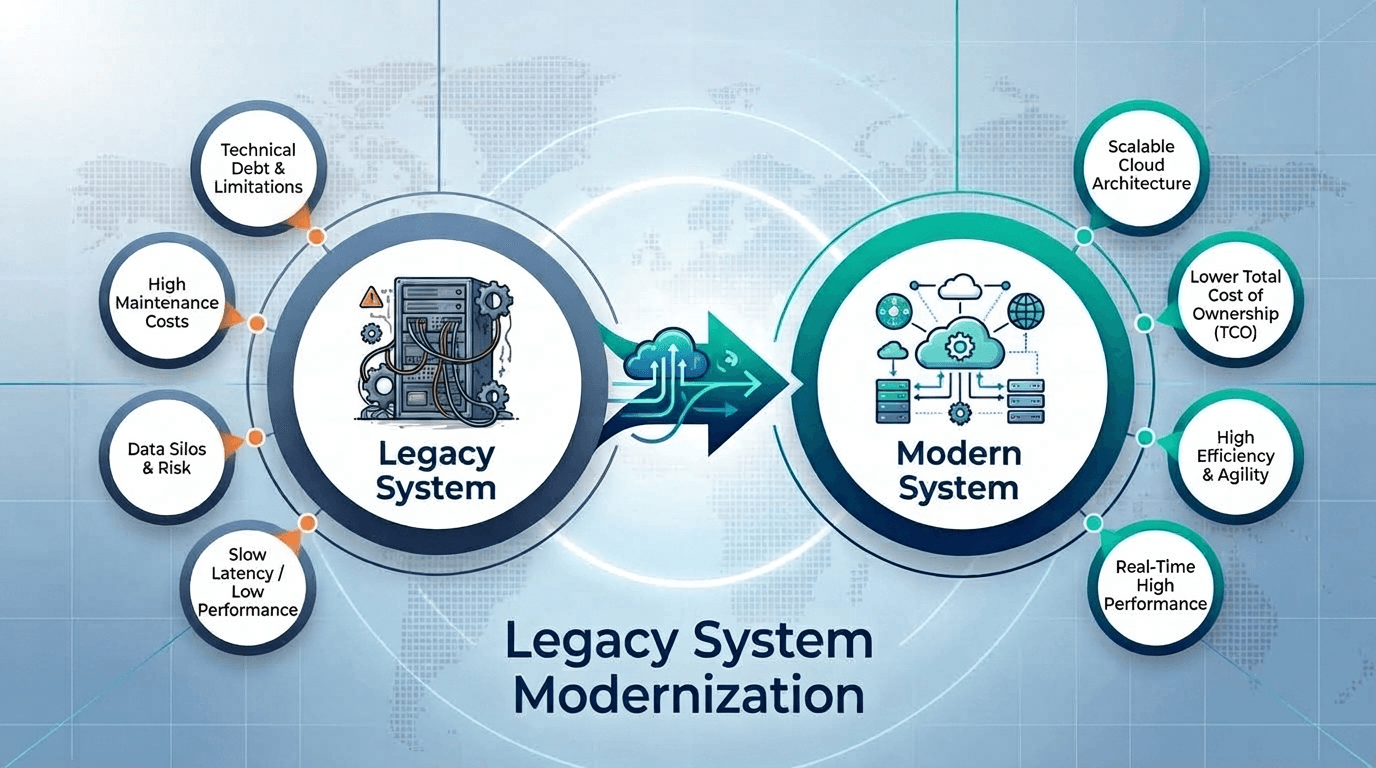
Choosing how to modernize is the decision that makes or breaks the project
What are the legacy modernization approaches?
- Choosing how to modernize is the decision that makes or breaks the project
- What are the 7 Rs of legacy system modernization?
- The seven approaches, explained
- A decision matrix for choosing an approach
- Why you keep seeing different lists of Rs
- Why teams pick the wrong approach
- Questions people ask about modernization approaches
- Where this fits in the bigger picture
- Why the right approach matters for cost and risk
- The money behind modernization approaches
- What clients ask us about modernization approaches
- Frequently asked questions about legacy modernization approaches
- Getting help choosing your approach
Most of the money in a modernization project is won or lost before anyone writes a line of code. It is decided the moment you pick your approach. Rehost a system that needed rebuilding and you carry the old problems into a new home. Rebuild one that only needed rehosting and you burn a year and a budget on work nobody asked for. This guide walks through the legacy system modernization approaches, the seven Rs, what each one actually means, and how to match the right one to each system you own. We will also clear up the confusion between the competing lists of Rs, because that alone trips up a lot of teams. By the end you will have a decision matrix you can use, not just a glossary.
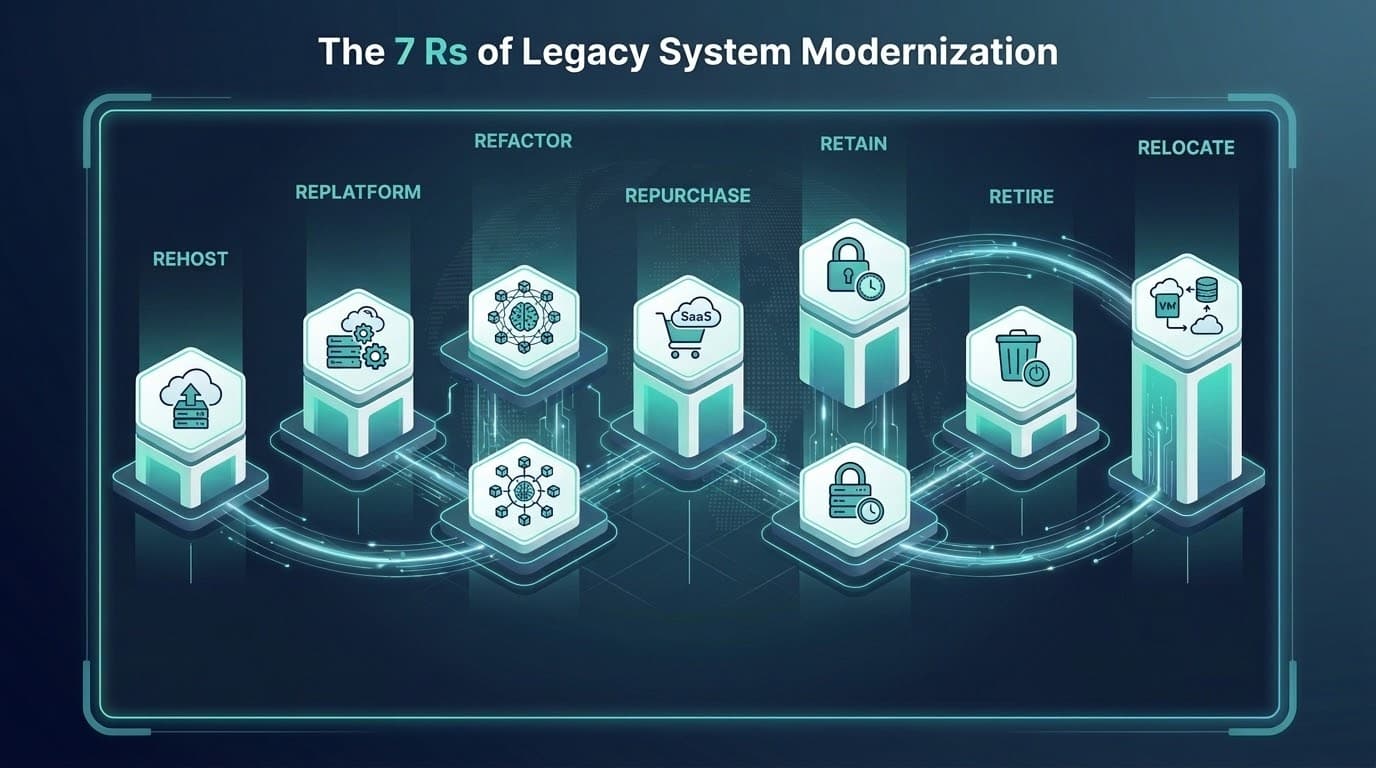
What are the 7 Rs of legacy system modernization?
Legacy modernization approaches are usually framed as the seven Rs, seven distinct paths for updating an aging system:
- Retain, leave it as is for now and revisit later
- Rehost, move it unchanged to modern infrastructure, often called lift-and-shift
- Replatform, move it with light changes to gain cloud benefits
- Refactor, restructure the code without changing what it does
- Rearchitect, reshape it into a modern architecture such as microservices
- Rebuild, rewrite it from scratch while keeping the same scope
- Replace, swap it for a commercial or SaaS product
The effort rises as you move down that list, and so does the payoff. Most real programs use more than one, a different R for different parts of the system, rather than forcing everything down a single path.
The seven approaches, explained
The lighter touch, retain, rehost and replatform
Not every system needs surgery. Retain is the honest choice for software that still works and is not blocking anyone. You document why you are leaving it and set a date to look again. It sounds like doing nothing, but a deliberate retain beats an accidental one. Rehost lifts the system onto modern infrastructure with the code untouched. It is fast, low risk, and the usual move when you need to exit a data center or cut hosting costs quickly. You get a better foundation without a redesign, which is why many teams pair it with a later refactor. Replatform goes a step further, making small changes during the move to pick up cloud benefits, swapping a self-managed database for a managed one, for example. It is the middle ground when rehosting leaves value on the table but a rewrite is overkill. All three often lead into a wider cloud migration.
The deeper changes, refactor, rearchitect, rebuild and replace
Refactor cleans up the code without changing what the system does for users. The behavior stays identical, the maintenance burden drops. It is the right call when the logic is sound but the code has grown tangled over the years. Rearchitect reshapes the structure itself, often breaking a single large application into a microservices architecture so parts can scale and change independently. You reach for it when scaling and speed of change are the real problem, not just messy code. Rebuild means rewriting from scratch with modern technology while keeping the same business scope, the system ends up technically new but still does its old job. It is the answer when the codebase is genuinely beyond saving. Replace retires the system entirely in favor of a commercial or SaaS product, which is the smart, cheaper move when an off-the-shelf tool now covers the need and your system holds nothing unique. The heavier paths usually run through solid backend and API development, since a modernized system lives or dies by its connections.
A decision matrix for choosing an approach
Here is the whole framework in one view. Read it per system, not per company, because the point of the seven Rs is that different systems in the same portfolio deserve different answers.
| Approach | What changes | Effort, cost and risk | Best when |
|---|---|---|---|
| Retain | Nothing, you document and revisit | Minimal | It still works and is not blocking anything |
| Rehost | Infrastructure only, code untouched | Low, fast, low risk | You need to exit a data center or cut hosting cost quickly |
| Replatform | Small tweaks for the cloud, same architecture | Low to medium | You want cloud gains without a redesign |
| Refactor | Internal code, behavior stays the same | Medium | The logic is sound but the code is hard to maintain |
| Rearchitect | The structure, often into microservices | High | Scaling and speed of change are the real problem |
| Rebuild | Everything, rewritten from scratch | High, higher risk | The codebase is beyond saving but the need remains |
| Replace | The whole app, swapped for a product | Medium, data-migration heavy | An off-the-shelf tool now covers the job well |
The takeaway is that there is no single best R. The best answer is a portfolio plan that assigns the right one to each system.
The three questions that decide it
Strip away the jargon and every choice comes down to three questions. How much business value does this system still deliver? How much pain is the current technology causing? And how much disruption can the team absorb right now? High value plus high pain points to rearchitecting or rebuilding. Low value plus low pain points to retain, or replace with something you buy. Most systems sit in between, which is why the phased answer, rehost first to stop the bleeding, then refactor what matters, is so common in practice.
Why you keep seeing different lists of Rs
If you have read a few guides and come away confused, you are not the problem. There are two overlapping frameworks in circulation. Gartner introduced a five Rs set for application modernization back in 2010, later widened by others. Separately, AWS popularized a seven Rs set built for cloud migration, retire, retain, rehost, relocate, repurchase, replatform and refactor. They cover similar ground but were designed for different jobs, one for reshaping application architecture, the other for moving workloads to the cloud. Most guides quietly pick one and ignore the other, which is exactly why teams end up comparing mismatched lists. We use a single, application-focused set throughout this guide so the paths map cleanly. If you see relocate or repurchase elsewhere, they are the cloud-migration cousins of rehost and replace.
Why teams pick the wrong approach
The rewrite trap
The most common mistake is reaching for rebuild because the old code is ugly. Ugly and working still beats beautiful and late. A full rewrite throws away years of hard-won edge cases that nobody documented, the odd rule someone added in 2016 that three departments now depend on. The second mistake is the opposite, rehosting everything to look busy while the real architectural problems ride along untouched. The fix for both is unglamorous, map what the system actually does, capability by capability, before you pick a strategy. When a modernization project blows its budget, the root cause is almost always a decision made without that map. We would rather spend an extra week understanding the system than a lost quarter reverse-engineering it mid-build.
Questions people ask about modernization approaches
A few come up in almost every planning session. Is rehosting or refactoring better? Neither, they solve different problems. Rehost for speed and infrastructure wins, refactor when the code itself is the obstacle. What is the difference between refactoring and rearchitecting? Refactoring cleans the code and leaves the structure alone. Rearchitecting changes the structure itself, usually to gain scale. Which approach is cheapest? Rehost, almost always, because the code does not change. It is also the one most likely to leave your real problems in place, so cheapest is not the same as best.
Where this fits in the bigger picture
Approaches are one piece of a larger decision. If you are still weighing whether to modernize at all, or want the full view of process, cost and timing, start with our complete guide to legacy system modernization. This piece zooms into the how, that one covers the why and the what.
Why the right approach matters for cost and risk
The gap between the cheapest and most expensive approach for the same system can be enormous, and picking wrong is expensive in both directions. Over-invest and you spend rebuild money on a rehost problem. Under-invest and you pay twice, once for the quick fix and again when it fails to solve anything. There is also a timing cost. The tools every business wants next, AI features, real-time data, automation, all assume a clean, connected foundation, so the approach you choose today quietly sets what you can build in two years. Getting the decision right is less about the technology and more about honest judgment, which is the whole reason we start with discovery. For the full picture of how these choices play out over a project, our legacy modernization guide lays it out end to end.
The money behind modernization approaches
The approach you pick moves the bill more than any other factor. Legacy application modernization runs from around 25,000 dollars for a straightforward migration to 2 million dollars or more for a large enterprise transformation, with most programs landing between 450,000 and 2.3 million. Rehosting sits at the low end, a full rebuild at the high end. Zoom out and the demand is clear, the application modernization market sits near 27.5 billion dollars in 2026 and is projected to reach about 68 billion by 2031, growing close to 20 percent a year.
© techneth.com
The right approach is rarely the most impressive one. It is the one that solves the actual problem for the least risk, and half our job is talking clients out of the rewrite they thought they wanted. That honesty is the through-line of how we work, described on our about Techneth page.
What clients ask us about modernization approaches
Which approach will you recommend for us?
We decide after discovery, not before. We map how each system is used, what it is worth to the business, and how much pain the current technology causes, then recommend an R per system. Often it is a mix, and we will explain the trade-offs rather than push the biggest project.
How do you choose between refactoring and rebuilding?
We refactor when the business logic is sound and only the code needs cleaning up, since that keeps years of hard-won detail intact. We rebuild only when the codebase is genuinely beyond repair. Rebuilding is the last resort, not the default, because it carries the most cost and risk.
Can you modernize with a mix of approaches?
Yes, and usually we do. A real portfolio rarely fits one R. We might rehost one system for a quick infrastructure win, refactor another, and replace a third with a SaaS product. The plan assigns the right path to each system rather than forcing a single strategy across everything.
How do you keep our system running during the work?
We modernize in increments, running old and new side by side and switching one slice at a time once each is tested. The business keeps operating throughout. We work in two-week sprints with a demo at the end of each, so you see progress every week and can adjust as we go.
Do we own the code after a rebuild or refactor?
Yes. You own the code and the intellectual property outright, whichever approach we take. There is no lock-in to us as a vendor. We build so your own team can maintain the result if you choose, backed by post-launch support for as long as you want us involved.
Frequently asked questions about legacy modernization approaches
What are the 7 Rs of application modernization?
Retain, rehost, replatform, refactor, rearchitect, rebuild, and replace. They range from leaving a system alone, through moving it to new infrastructure, to a full rewrite or swapping in a commercial product. Each represents a different level of change, and most programs use several across a portfolio.
What is the difference between rehosting and replatforming?
Rehosting moves an application to new infrastructure with no code changes, a straight lift-and-shift. Replatforming makes small, targeted changes during the move to pick up cloud benefits, such as switching to a managed database, without redesigning the application. Replatforming is a slightly heavier lift for more payoff.
What is the difference between refactoring and rearchitecting?
Refactoring restructures the internal code while keeping the same behavior and overall structure. Rearchitecting changes the structure itself, for example splitting a single application into microservices, to improve scalability and speed of change. Rearchitecting is the bigger, higher-effort change of the two.
Is rehosting or refactoring better?
Neither is universally better, they solve different problems. Rehost when you need speed and an infrastructure upgrade without touching code. Refactor when the code itself is the obstacle to maintaining or extending the system. Many teams rehost first for a quick win, then refactor the parts that matter most.
What is the difference between the 7 Rs of cloud migration and application modernization?
The cloud-migration Rs, popularized by AWS, focus on moving workloads to the cloud and include relocate and repurchase. The application-modernization Rs focus on changing the application itself, its code and architecture. They overlap heavily but were built for different jobs, which is why the lists differ.
Which modernization approach is cheapest?
Rehosting is almost always the cheapest and fastest, because the application code does not change. The trade-off is that it does little to fix underlying architectural problems, so the lowest-cost option is not always the one that solves what you actually need to solve.
When should you rebuild instead of refactor?
Rebuild when the existing codebase is genuinely beyond saving, so unstable, undocumented, or outdated that cleaning it up costs more than starting over. If the business logic is sound and only the code is messy, refactoring is safer and cheaper. Rebuild is a last resort, not a first choice.
What is lift and shift?
Lift-and-shift is another name for rehosting, moving an application to new infrastructure, often the cloud, without changing its code or architecture. It is quick and low risk, useful for exiting a data center or cutting hosting costs, but it does not deliver cloud-native optimization on its own.
What does retire mean in application modernization?
Retire means decommissioning an application entirely because it is no longer needed, often after its function has been absorbed elsewhere or replaced. Alongside retain, it is a reminder that not every legacy system should be modernized, sometimes the right move is to switch it off cleanly.
How do you choose the right modernization approach?
Assess each system on three points, the business value it still delivers, how much pain its technology causes, and how much disruption you can absorb. High value and high pain justify deeper approaches like rearchitecting. Low value and low pain point to retain or replace. Decide per system, not per company.
Getting help choosing your approach
If you are staring at a portfolio and not sure which R goes where, that is exactly the conversation worth having early, before any code. You can book a free consultation and we will help you map each system to the approach that fits it.
You can also learn more about Techneth and how we work, explore our full range of services including cloud migration and microservices architecture, see real projects in our portfolio, or reach us through our contact page.
For the full picture of process, cost and timing around all of this, the natural next read is our complete guide to legacy system modernization.