The decision behind every legacy fix, improve it or start over
Refactor or rewrite, which one is right for your system?
- The decision behind every legacy fix, improve it or start over
- The short answer, choose refactor if, choose rewrite if
- How we compared the two
- Refactor vs rewrite at a glance
- The comparison, dimension by dimension
- The option most guides skip, do both
- Best for, who should pick which
- Where we stand, honestly
- Why choosing wrong is so expensive
- Refactor and rewrite by the numbers
- What clients ask us about refactor vs rewrite
- Frequently asked questions about refactor vs rewrite
- Deciding your path
This is a fair fight, so we will call the wins on both sides. Refactoring and rewriting are the two real ways to fix aging software, and each is genuinely the right answer in some situations and genuinely the wrong one in others. Refactor when you can, rewrite when you must, is the short version, but the interesting part is knowing which case you are in. We build software both ways at Techneth, so we have watched refactors quietly rescue systems everyone had written off, and we have watched rewrites swallow a year and a budget before delivering anything. This piece compares the two on the dimensions that actually decide it, cost, risk, timeline, and reach, then maps out who should pick which.
The short answer, choose refactor if, choose rewrite if
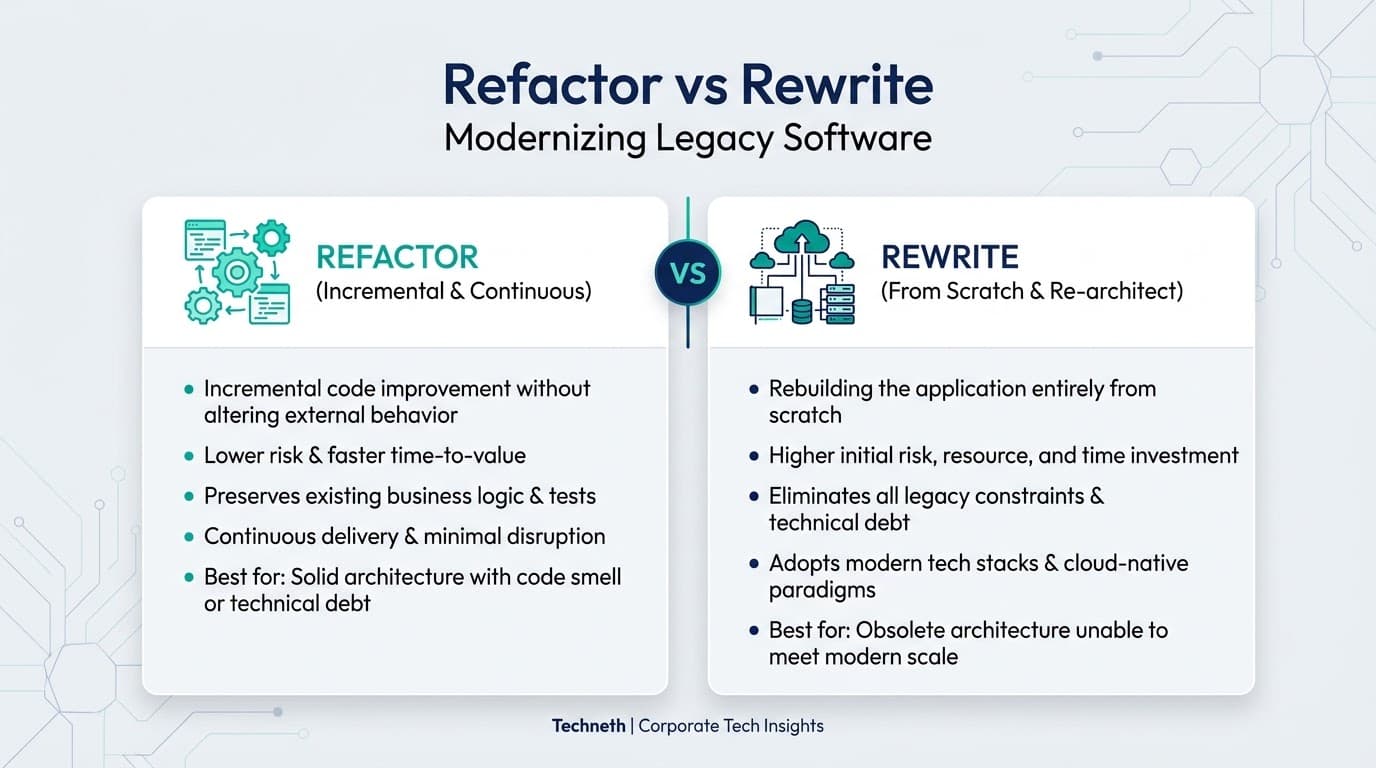
Choose refactoring if the core logic still works, the language and framework are still supported, and your main problem is messy, hard-to-maintain code. It is lower risk, costs less, and delivers value in weeks rather than months. Choose rewriting if the language or framework is obsolete, security updates are blocked, key integrations are impossible, or the code is so brittle that adding a feature breaks three others. Rewriting is the heavier, riskier path, and it should be a last resort, not a first instinct. In practice, the best answer for many systems is a mix of both, and we get to that below.
How we compared the two
We weighed the two approaches on the four things that decide most real projects, in rough order of how much they matter. Risk comes first, because a modernization that fails costs more than one that is merely slow. Cost and time to value come next, since a business has to keep running while the work happens. Reach is third, how much of the problem the approach can actually solve. Knowledge preservation is the quiet fourth, because legacy systems hold years of undocumented rules that are easy to lose. The figures below reflect widely reported industry data as of 2026, not a single vendor's marketing.
Refactor vs rewrite at a glance
Read down the Risk and Cost rows and the pattern is clear, refactoring is the safer default and rewriting is the bigger bet you take only when the system leaves you no choice.
The comparison, dimension by dimension
Risk and the odds of success
This is where the two diverge most. Refactoring is incremental, you improve the code in small, testable steps while the system keeps running, so if something goes wrong you catch it early and roll back. Rewriting is a bigger swing. Industry studies as of 2026 suggest that somewhere between 60 and 80 percent of software rewrites either fail to deliver their expected benefits or get cancelled outright, and the ones that succeed commonly run 2 to 3 times longer than planned. Martin Fowler, who literally wrote the book on refactoring, has long argued that a from-scratch rewrite should be treated as a last resort because of how easily regressions creep in. That is not an argument against ever rewriting. It is an argument for being honest about the odds before you commit.
Cost and time to value
Refactoring tends to cost roughly a third of a comparable rewrite, and it pays back sooner because improvements ship continuously, you feel the benefit within weeks. A rewrite defers all its value to the end. You often maintain the old system and build the new one at the same time, which splits your team and your budget across two codebases for months or years. Here is the fair counterpoint, though. When a rewrite is genuinely warranted, refactoring around a broken foundation just delays the inevitable and you can end up paying twice, once to patch and again to replace. Cheapest per month is not the same as cheapest overall.
How much each one can actually fix
This is the dimension where rewriting earns its keep. Refactoring works on any architecture and cleans up code beautifully, but it cannot undo a fundamentally wrong structure. If your system is a tangled monolith that cannot scale no matter how tidy the code gets, refactoring has a ceiling. A rewrite, or a rearchitecture into something like a microservices architecture, is what lets you break that ceiling. So the honest trade is this, refactoring gives you safety and speed but limited reach, rewriting gives you unlimited reach but at real risk and cost.
The option most guides skip, do both
The refactor-or-rewrite framing is a bit of a false binary. On real projects the smartest path is often a hybrid, keep and refactor the parts that still serve you, rewrite only the parts that are holding you back. Picture a legacy platform with a solid backend but a painful, outdated interface. You would refactor the backend to make it maintainable and rewrite the frontend on a modern framework, rather than tearing down the whole thing. This is exactly the thinking behind the strangler pattern, where you build new pieces around the old system and retire it gradually. It gives you much of the rewrite's upside with far less of its risk, which is why it is our default recommendation more often than either pure approach. It sits comfortably alongside the other paths in our guide to legacy modernization approaches.
Best for, who should pick which
Refactor is best for teams whose software still does its job but has grown slow to change, where the language and framework are current, and where the business cannot afford a long freeze on new features. Rewrite is best for systems built on obsolete or unsupported technology, where security cannot be maintained, or where the architecture itself blocks what the business now needs. A hybrid is best for most mid-size systems in between, where some parts are worth saving and others are not. If you are not sure which bucket you are in, that uncertainty is itself a signal, it usually means you need a proper look at the code before committing either way.
Where we stand, honestly
A fair disclosure, since we offer both, we have no reason to push you toward the bigger project. If anything our bias runs the other way, we would rather talk a client out of an unnecessary rewrite than sell one, because a failed rewrite damages the relationship far more than a modest refactor ever could. We are not the right fit if you have already decided to rewrite for reasons of preference rather than necessity and just want hands to build it. We work best with teams who want an honest read on which path the system actually needs.
Why choosing wrong is so expensive
The cost of the wrong call is not just money, it is momentum. Commit to a rewrite that stalls and you spend a year with nothing shipped while competitors move. Keep refactoring a system that needed replacing and you pour effort into a foundation that will crack again. Legacy drag is already real, surveys as of 2026 report that around 90 percent of IT decision-makers feel legacy software holds them back, and roughly three quarters have had critical data trapped inside systems they could no longer easily access. Getting this decision right is the difference between modernization that frees the business and modernization that quietly repeats the problem. If you want the wider view of process, cost and timing, start with our complete guide to legacy system modernization.
Refactor and rewrite by the numbers
The data lands firmly on the side of caution with rewrites. As of 2026, between 60 and 80 percent of rewrites miss their goals or get cancelled, and successful ones tend to cost 2 to 4 times their first estimate. Refactoring, by contrast, usually runs about a third of a rewrite's cost. The pressure to act is real too, roughly 90 percent of IT leaders say legacy software holds them back, and about 76 percent have seen critical data locked inside legacy systems.
© techneth.com
The rewrite that feels exciting on day one is the one that scares us most by month six. When in doubt, refactor, and rewrite only the piece you genuinely cannot save. That caution is the through-line in how we work, described on our about Techneth page.
What clients ask us about refactor vs rewrite
Do you recommend refactoring or rewriting?
It depends on the system, and often the honest answer is a hybrid. We refactor what still works and rewrite only what genuinely holds you back. We do both, so we have no incentive to push the bigger project, and we will tell you plainly when a smaller effort would serve you better.
How do you decide which is right for us?
We start with discovery, mapping how the system is used, how sound the code and architecture are, and how much disruption you can absorb. Only then do we recommend a path. That upfront look is where most surprises hide, and skipping it is the main reason modernization projects overrun.
Can you do a hybrid of both?
Yes, and we often do. A common pattern is refactoring a stable backend while rewriting an outdated frontend, or using the strangler approach to replace parts of a system gradually. It captures much of a rewrite's upside with far less risk, which is why it is frequently our recommendation.
Will our system keep running during the work?
Yes. We work incrementally, keeping the current system live and switching over one piece at a time once it is tested. We deliver in two-week sprints with a demo at the end of each, so you see progress every week and the business never goes dark during the transition.
Do we own the code afterward?
Yes, you own the code and the intellectual property outright, whether we refactor or rewrite. There is no vendor lock-in. We build so your own team can maintain the result if you choose, and we stay available for post-launch support for as long as you want us involved.
Frequently asked questions about refactor vs rewrite
What is the difference between refactoring and rewriting?
Refactoring restructures existing code to make it cleaner and easier to maintain without changing what the software does. Rewriting discards the old codebase and builds a new system from scratch, usually on modern technology. Refactoring improves what you have, rewriting replaces it entirely.
When should you refactor instead of rewrite?
Refactor when the core logic still works, the language and framework are still supported, and the main problem is messy or hard-to-maintain code. It is lower risk and cheaper, and it delivers improvements in weeks rather than deferring all value to the end of a long project.
When should you rewrite instead of refactor?
Rewrite when the language or framework is obsolete, security patches are blocked, essential integrations are impossible, or the code is so brittle that any change breaks something else. In short, rewrite when the foundation itself is the problem and no amount of cleanup can fix it.
Why are software rewrites so risky?
Rewrites are large, all-or-nothing efforts that defer value to the end and split teams across two codebases. Industry data suggests 60 to 80 percent miss their goals or get cancelled, and successful ones often run far over time and budget. Undocumented business logic is also easily lost.
Can you combine refactoring and rewriting?
Yes, and it is often the best path. A hybrid keeps and refactors the parts that still work while rewriting only the parts that hold you back, frequently using the strangler pattern to replace pieces gradually. It captures much of a rewrite's benefit with considerably less risk.
How long does a refactor take compared to a rewrite?
Refactoring shows value within weeks and continues incrementally alongside normal development. A full rewrite typically spans many months to a few years, with benefits arriving only once it is complete. That difference in time to value is one of the biggest practical reasons to prefer refactoring when it fits.
How much does a rewrite cost compared to refactoring?
Refactoring usually costs around a third of a comparable rewrite, and pays back sooner because improvements ship continuously. Rewrites often exceed their initial estimates by 2 to 4 times, partly because teams maintain the old system while building the new one. Cheapest overall is not always the obvious choice.
Does refactoring change how the software behaves?
No. Proper refactoring changes the internal structure of the code while keeping its external behavior identical. Users should not notice any functional difference, only, over time, a system that is faster to improve and less prone to breaking when changes are made.
What is the risk of losing business logic in a rewrite?
Legacy systems often encode years of undocumented rules and edge cases. In a rewrite, anything not written down can be missed, so the new system quietly behaves differently in ways that surface later. Careful discovery and mapping before a rewrite is the main defense against this.
Deciding your path
If you match where we fit best, a team that wants an honest read before committing, the right next step is a short look at your actual code and architecture. You can book a free consultation and we will tell you plainly whether your system calls for a refactor, a rewrite, or a mix of the two.
You can also learn more about Techneth and how we work, explore our full range of services including backend and API development and cloud migration, see real projects in our portfolio, or reach us through our contact page.
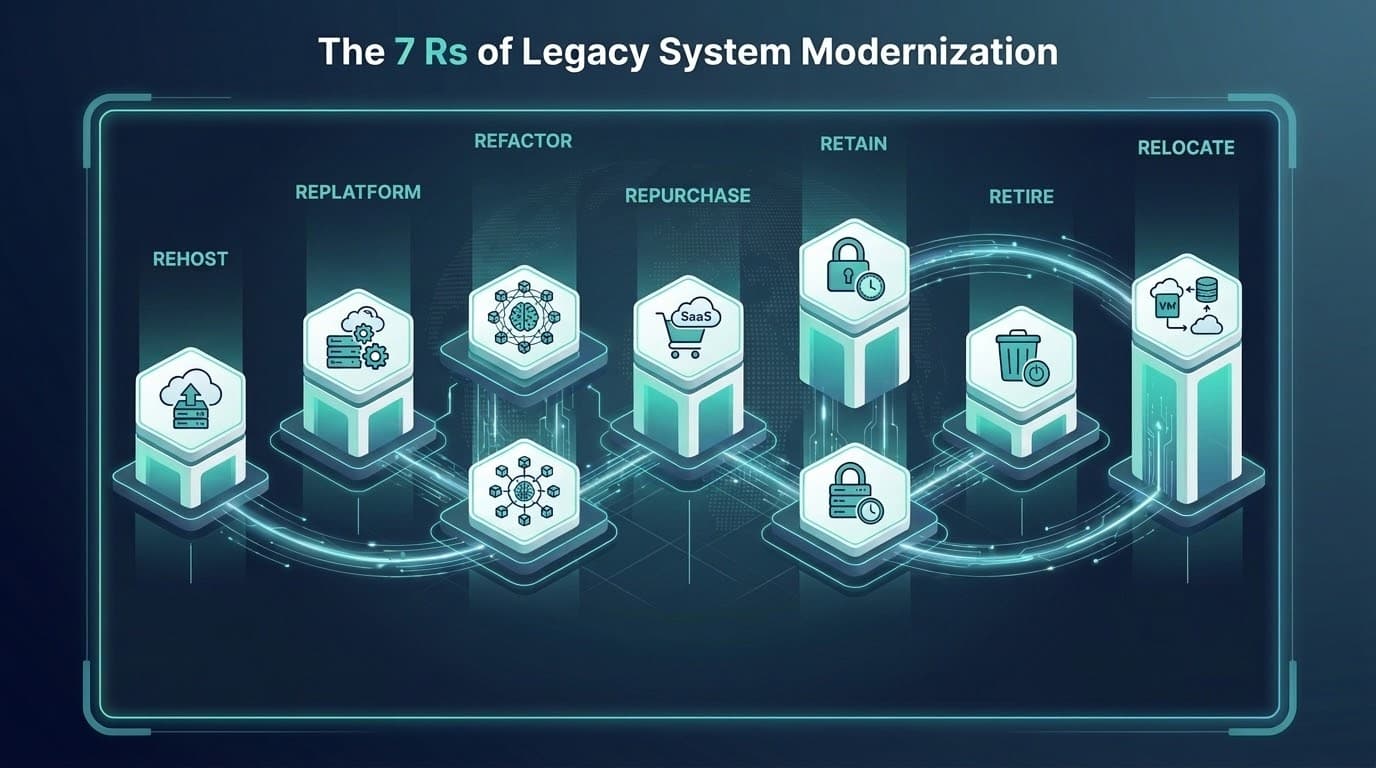
For the full set of options beyond these two, the natural next read is our guide to the seven legacy modernization approaches.